Showing posts with label Bucket List. Show all posts

Monday, August 6, 2012

Ostomate Carries a Moose


Oct 2010
As an ostomate I have been told … avoid extreme activities, don’t lift big weights, don’t over-exert.  As a hunter I have been told … never hunt alone, a moose is too big for 1 person to handle, you need a truck or a quad for moosehunting.    I ignored all these suggestions.

I was reluctant to write this story, not wanting to offend those who dislike hunting, nor those who decline to eat meat. I have full respect for those differing opinions, and make no attempt to change them.  I hope others will quietly allow me mine.

In 2009 I was recovering from cancer and a colostomy, so didn’t hunt, and wondered if I would be able to hunt again.  It became a must-do on my Ostomy Bucket list. 

There are 3 parallel forces that take me hunting.  Philosophically … I easily connect with the natural world, and feel very comfortable and belonging while alone in the bush.  And Practically ….for the past 20 years, several families anticipate the steaks, roasts, and burger from my moose hunts.  And Ancestrally ... there is something buried deep in the reptile part of our brain that makes us hunters, gatherers, and survivors.  And yes, perhaps spending too much time alone in the bush, conjures up such thoughts :)

A Canada Moose stands 6 feet (2metres) tall at the shoulders, and can weigh up to 1500 pounds (700Kgs). 

My location is NorthWestern Canada.  I drive 4 hours from my home to the end of the road, then 28km by boat to my cabin.  I will be alone, and I will hunt every day for the next 10 days.  Here is a typical day. 
I woke to the alarm at 4:30am.  Made a thermos of coffee and ate a bowl of porridge.  Left the cabin at 5:00am.  It was very dark this morning, as it was cloudy and with almost no moon.  When it is this dark, it’s good to have the route in my head, and take clues from surrounding terrain to avoid being lost or hitting rocks.  After a dark 4km boatride, I transferred to a canoe and paddled 400meters up a small creek. Canoeing up the creek is more difficult than the lake travel, as I am low to the water, the creek is only 2meters wide with tall reeds growing on both sides, and VERY winding.  I did some moose cow-calls that can be heard (by bull moose) for up to 5 kms.  


By 10:30am it was obvious that no bull moose would be showing this morning, so I reversed my route and returned to the cabin.  Lunch, a short nap, a few chores, then back out for the evening hunt from about 4:00pm to sunset at 7:30pm.
These are long days, with 8-9 hours of sitting, silently, and moving only my eyeballs.  Many similar days passed.  On a typical moosehunting day … nothing happens.
One morning, I thought I heard a moose walking slowly in the creek, then quickly climb the bank, splashing as he lunged out of the water.  This added to a number of events that have tricked me over the years.  The noise was actually a flock of ducks that had probably slept in a bay on the creek.  A few started to move and stretch their wings, then they all stretched and splashed thru the water as they took flight.  Not a moose, but a new, exciting, and uncommon observation anyway.

On day 7, I woke to the alarm at 4:30am.  It was drizzling, and the forecast was for light rain all morning.  Staying in bed seemed tempting, but I decided to go hunting anyway.  It was so dark – no moon and heavy clouds.  Navigating in the dark was difficult as the terrain-clues were harder to see, and distance from shore was difficult to judge.  I traveled at lower speed, but it seemed like I was going way too fast for conditions (like overdriving your headlights, except there was no light).  At 9:30am the drizzle was tempting me to go back to the cabin, but then I heard a branch snap.  Doesn’t count as a moose until I have at least 3 clues (branch snaps, grunts, raking antlers, walking in water…) or actually SEE the moose.  He was just a silhouette, standing in the heavy bush.  I had to use binoculars to positively identify him.  I wanted a broadside shot, so waited.  Finally, at 40 yards, he turned and stood broadside, and I hit him with a good double-lung shot. He walked away, about 30 yards and went down.  I watched him thru the binoculars.  

I took a few pictures, then gathered my things, and went back to the cabin.  I assembled the gear I would need, ate a hearty meal, then returned to the site.  He had gone down in a burned area, so the entire forest floor was black and all the dead trees and shrubs were black.  And of course my clothes were blackened with the char.  I was glad that he wasn’t a big moose (there are no small moose when you are working alone).  Young or big or full-of-shit guys talk about quartering a moose.  A moose is only as heavy as the pieces you cut, so I cut him into ninths.  I hauled each piece about 50 yards, and loaded the 9 pieces in the boat.  

It was 5:30pm when I got back to the cabin.  It was tough lifting to get all the pieces from the boat up onto the dock.  It took 2 full hours to clean the pieces and  wrap them in bedsheets (to keep them clean and keep any flies off them).  
It was dark by the time I finished.  

It was a long hard day for a 61-year-old ostomate to handle a moose by himself.  
Despite the excitement of the day, sleep came easily that night.

This was an exhausting but immensely rewarding day for me.  Another Ostomy BucketList accomplishment 
… yes, I can still moosehunt with an ostomy.

And I earned freedom from ‘the rules’…
avoid extreme activities ... NOT
don’t lift big weights ... NOT
don’t over-exert ... NOT
never hunt alone ... NOT
a moose is too big for 1 person to handle ... NOT
need a truck or quad for moosehunting ... NOT

Saturday, May 19, 2012

Greg Doesn’t Golf anymore


Greg was the spark that started this Living Bigger With Colostomy blog. 

Greg golfed 6 days a week for 30 summers, then was diagnosed with T3 colon cancer, which resulted in surgery for a colostomy, as well as chemo and radiation.  

Greg quit golfing, fearing the embarrassment of changing a pouch while his golf-buddies waited, or the horrors of a pouch explosion.

Greg also quit driving and riding in a car, for fear of the seatbelt rubbing on his stoma.

Greg declined to lift grocery bags, for fear of a hernia.

Greg stayed in his house, intentionally remaining inactive, and gained enough weight that his pants didn’t fit.  So he started wearing his pouch outside his pants.  With this new humiliation, he refused to leave his house … so both Greg and his wife became reclusive.  This soon dragged both of them into a depression which brought apathy, and lowered confidence and motivation.  Soon Greg’s wife was changing his appliances for him, and they spiraled down together.

Greg and I talked a lot.  Cautiously, I shared many of my positive and active experiences living a normal life with a colostomy – wanting to show that he and his wife could live bigger, yet not wanting to intimidate with my adventures that would be unbelievable and unrealistic for him.  We had a few successes:

  • Seatbelts – I drive, and carried a backpack with a hipbelt for 40 days.  Its OK for Greg to drive and ride.
  • Pouch on the Outside – Buy pants 2 inches bigger, wear suspenders, and get the pouch back inside your pants!
  • Pouch Explosions Golfing – I have golfed for 2 years and played over 100 hockey games (taking hits and blocking shots) and have never had an explosion. Greg is safe to golf ... and no reason to be embarrassed changing pouches on the golf-course, being much more environmentally sensitive than his buddies that relieve beer-overloads in the bushes.
 These small incremental successes are positive and encouraging.

Golfing with Greg is now on my bucket list !

Friday, March 30, 2012

Nepal2011: Colostomy Got Me Here

May 2011
Trekking to Everest Base Camp was an absolutely awesome trek! 
I can honestly say there was not a single minute when I thought I would rather be somewhere else.  Really!
I couldn’t dream for more … 

Spectacular Nepalese landscape

Happy & friendly Nepalese people

A varied but like-minded team from Canada

Physically & mentally challenging trek


Trekking to Everest Base Camp
was on my ‘bucket list’ for decades.


Cancer & Colostomy motivated me to

Just do it !

Sunday, March 25, 2012

Nepal2011: Summit Kala Patthar

May 2011
For trekkers wanting the big-view of Everest … overnight at Gorak Shep, wake-up at 3:45am, ascend Kala Patthar in the dark, and watch the sunrise on Everest.  But, It’s not that easy. 

Acute Mountain Sickness (AMS) is caused by a combination of reduced air pressure and lower oxygen levels at high altitudes [beyond 2400m / 8000ft].  Gorak Shep is 5164m / 16942m.  Kala Patthar is 5545m / 18192ft.  By the time we reached Gorak Shep, AMS had taken its toll on our group.  Some people stayed in their warm sleeping bags, rather than face the dark, cold, windy, harshness of the climb – for days they have been hurting from AMS-induced dizziness, fatigue, lethargy, and screamer-headaches.  Some of us were fortunate to not have these symptoms, nor the rib-rattling cough, nor the loss-of-appetite that robs strength and resolve. 


The climb is long, slow, and relentless.  The air has 50% of the oxygen that we expect at sea-level.  Lungs work harder to compensate.  Heartrate rises to force more blood to the big muscles. Muscles resist and retaliate when being pushed on half-rations of oxygen.  We each
struggle to find the strength and drive
to continue moving upward.  
Few words are spoken.  People stop for their own reasons - maybe only a rest, or to clear their foggy brain, or to question the pain vs the reward of this summit, or to deal with the nausea & pending vomiting, or from their body’s refusal to continue.  It’s not predictable who will be stopped by AMS.

Kala Patthur with Pumori in the background
I could see the prayer flags ripping on the wind swept summit.  How hard could it be to climb those last 100 meters?  I was amazed at how slowly I progressed.  Focusing mindlessly on my feet, it occurred to me that 
Each step was less
than the length of my boots! 

I was pushing myself, mentally and physically, and 
All I had left was 6 inch strides!  


My thoughts were simple.
Keep moving ... just one step at a time. 


2 Cancer Survivors and our guide Ganesh at Kala Patthur summit
Six of our team, ages 57 to 62 summitted Kala Patthar.  Summiting was worth the pain.The clouds cleared and the sun rose, showing  Everest with its perennial plume of snow blowing over its summit.

We spent 45 minutes on top of Kala Patthar, celebrating our accomplishment, hanging prayer flags, and taking pictures, yet regretting the absence of fellow-trekkers with whom we had shared the last 20 days.  The walk down had less physical exertion, but we remained focused, well aware of the perils of fatigue while descending.


Everest as seen from summit of Kala Patthur
Why did elders summit, when younger people didn’t?  
Maybe the elders were attuned to their aging bodies and avoided AMS by methodically moving ‘mountain-slow’.  Maybe the elders knew this was a once-in-a-lifetime shot, and they wouldn’t quit until they had nothing left.


Living Bigger with Colostomy on Kala Patthar summit 


Rob Hill climbed the SevenSummits
I climbed Kala Patthar
We all have our own mountains to climb.


Yes we can.  Ostomates can climb mountains.


For another perspective of this event, read what trip leader Tami wrote:

Saturday, March 24, 2012

Nepal2011: Everest Base Camp


It is a cold, desolate, hilly climb along the Khumbu Glacier from Gorek Shep (5164m / 16942ft) to Everest Base Camp (5364m / 17598ft). The air has 50% less oxygen than at sea level.  Our lungs struggle to fuel our bodies, and our muscles retaliate as we push them relentlessly on half-rations of oxygen.  The rocky moraine and the aging glacier ensure there is no sustainable vegetation or animal life here.   


The massive faces of Everest, Nuptse, and Lhotse tower above us.  It seems natural to feel very small in this place.  The big mountains seem intimidating, and certainly not inviting.  


It is customary and respectful to hang Prayer Flags


We all felt honoured and privileged to be here. Everest Base Camp is a special place.  For some, it is a lifetime bucket-list highlight.  For others it is the destination at the end of a long trekk. 


But for the 5 cancer survivors there was a special connecting bond.

We spontaneously joined in a circular huddle with eyes closed and heads bowed.  To us, it seemed the wind and snow stopped, and the 5 of us were alone. We each experienced our personal flashback - from the cancer, through treatment, through recovery, to standing together at Everest Basecamp.  As if controlled by a single mind, we simultaneously raised our heads and met the eyes of our fellow survivors. 
One survivor said 
'We are alive, and We are here on Everest’
Emotions were shown by some, felt by all
Thankful, Joyful, Peaceful, Proud, Hopeful

The huddle split into a line, Ashok joined us, and someone took this picture. 
Living is hard.  Life is a struggle.  Enjoy it.   

This same event is told with more insightful, eloquent, and artistic flair by our Trip Leader Tami.

Tuesday, March 20, 2012

Hike Lake O'Hara

August 2011
Lake O’Hara is one of the Premier Hikes of the Canadian Rocky Mountains.


Lake O'Hara must be one of the most beautiful places on earth.  Spectacular views of glacier-clad peaks, surreal mountain lakes, alpine meadows, and rushing icy streams of glacial melt. 

Rugged alpine vegetation and wildflowers growing in a harsh environment.  Pikas, marmots, and goats are at home.We hiked and climbed for 3 glorious, rugged, challenging days.   We camped and enjoyed cosy fires together for 2 nights.


It takes some grit and determination to see this jewel. 
Most Ostomates will never experience Lake O’Hara.
My Colostomy enabled me to experience Lake O’Hara.
My family enjoys camping and hiking, and connects easily with the natural world.
 After cancer and surgery, I simplified life to do more of what I want to do
and less of what others think I am obligated to do.
I now have more time to spend with family, doing the things we enjoy.

Yes we can.  Ostomates can experience rugged places.

Tuesday, March 13, 2012

DayHike Haleakala

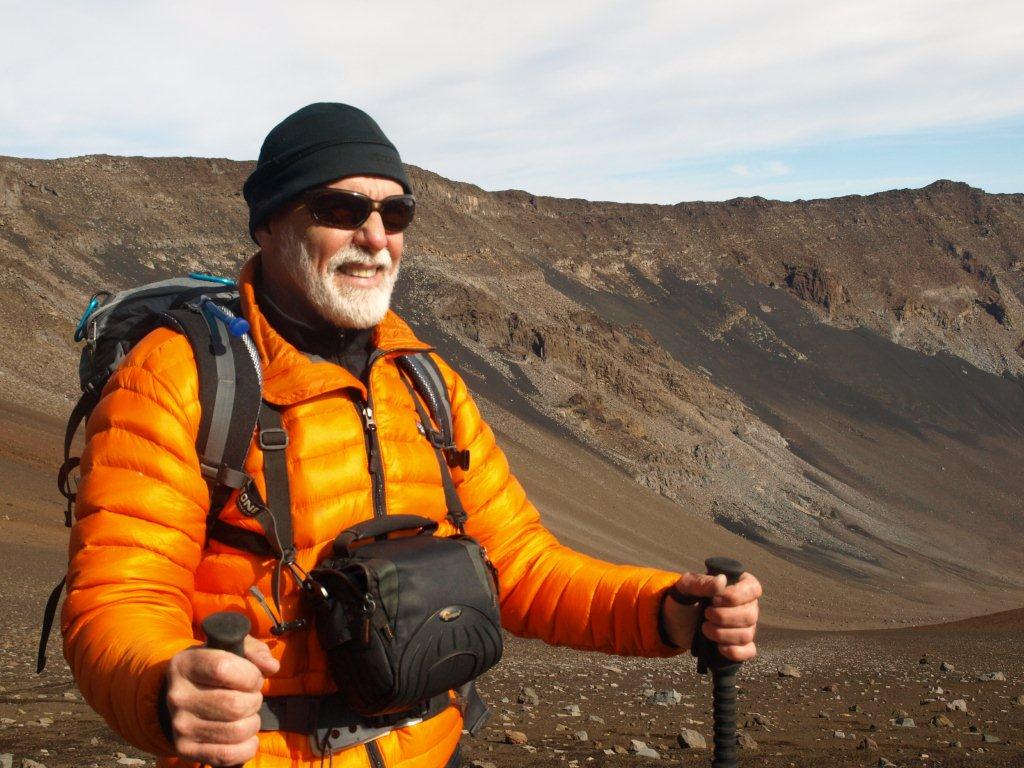
Haleakala is the highest point on Maui and the largest dormant volcano on earth.  A 2-hour drive in the darkness, climbing uncountable switchbacks, took us from sea-level to about 10,000 feet of elevation.
 
We arrived before dawn to see the sun rise from the east, as we stood at the top of the massive crater. 

The sky and clouds showed spectacular colours, the mist sank down the crater edges, and the sculpted landscape seemed to unfold with the new golden light.

Standing and observing from the top is a memorable experience.  But taking a 16 mile hike down, into, and through the crater is a much richer experience.  It is a rugged hike, with elevation decent and climb of 2000 feet.  The landscape is unearthly, with expansive fields of cinders and lava flows, a desert of sand from eroded peaks, and a very few rare and hardy Hawaiian plants. 


Inside Haleakala is a spectacular experience, but it takes considerable effort to get there.
 
Many ostomates will miss this experience because it’s ‘too physical’, or they could dehydrate, or won’t carry a backpack for fear stoma-rubbing or flange-peeling. 


YES we can.  Ostomates can DayHike to spectacular places.

Maui, February 2012

Sunday, March 4, 2012

Comeback to Hockey


December2009 [4 months after surgery]

I had Traded Cancer for a Colostomy 
then  Recovered with Rehab 
                              from Colostomy&Resection Surgery


Exactly 4 months after surgery, I was back playing hockey.
This was the first big test of my conviction that 
After surgery
I will do everything I could do before surgery
The first milestone was to earn confidence that I could block shots and take the hits … without an explosion!  

Hockey Talk
Hockey team-mates were curious about what had happened to me, so I volunteered to answer any questions they had, and show them anything they wanted to see … and that had a way of dispensing with what could have been an uncomfortable situation.  Players aged 50-65 parade around the dressing room and shower together after games – and we jokingly concluded that even with an ostomy, my body would not be the worst among the variety of sizes and shapes!     

News of my cancer and surgery somehow travelled around the league of about 250 hockey players.  As I played ‘first game back’ with each team, I was amazed at how many players made a point of acknowledgement, usually with the back-handed male style ... 
'Didn't slow you down a bit'

'Nice you're back, looking dangerous as ever'

‘I always hated going into the corner with you, 
but now I’m really afraid of the shit flying’

‘I thought with your butt sewn shut, 
that your stride would be shorter’ 

It was all sincere and heartfelt, but the presentation
was the just the best that men that age can do.  


You're the one
After an aggressive altercation around the net, a large and hostile defenseman pummeled me with a verbal tirade of hockey-trash-talk including “…#@*& ass-hole …”.    I sniped back ‘you can’t really call me that, because I don’t even have one’.  Instantly he went silent, smiled, put his arm around my shoulder, and said in amazement “you’re the one”, knowing only that someone in the league had been hurt by cancer and surgery, but had recovered.


Read the full story of  my 
Comeback to Hockey


Yes we  can.  
Ostomates can play Hockey.