Showing posts with label Hiking. Show all posts

Saturday, March 31, 2012

Nepal2011: We are SO Fortunate

May 2011
We are unimaginably wealthy, compared to Nepalese standards …
Nepal is the poorest country in South Asia, and the 12th poorest country in the world
Average ANNUAL income is $450
57% of Nepalese live for under $60 per month -  30% live for under $12 per month
50% of Nepalese children under 5 years of age, are malnourished
Life expectancy for men is 63 years, and for women is 64 years.  Less in the countryside
Child mortality is the highest in Asia.  Maternal mortality is the highest in the world
Education, HealthCare and Drinking Water are NOT available to all

To travel in Nepal is to step into the bottom of the Third World. 

We have so much – they have so little.  
Yet it seems most countryside Nepalese are happier than we are.
Public Transportation means you walk

There are few roads.  Everything is hauled on someone’s back

Housing standards are not the same as ours
Stone buildings means every ‘brick’ is hand carved
In the countryside, there are no flush toilets
These woman in these kitchens will prepare meals for 20 guests
Nepalese People work hard
Yet Nepalese people seem genuinely happy

Sometimes we may think life is treating us badly so we feel justified to complain
But our hardships are insignificant in comparison with the life struggles of most Nepalese people. 

I found no Ostomy Supplies in Nepal. 
Our Nepalese guide was shocked by my Colostomy,
having never even heard about ostomies.  

It occurred to me that there are few (if any) ostomates in Nepal. 

People in Nepal don’t have ostomies – they just die
Considering this alternative ...
We are all so very fortunate to be alive

We should not complain. Ever.

Friday, March 30, 2012

Nepal2011: Colostomy Got Me Here

May 2011
Trekking to Everest Base Camp was an absolutely awesome trek! 
I can honestly say there was not a single minute when I thought I would rather be somewhere else.  Really!
I couldn’t dream for more … 

Spectacular Nepalese landscape

Happy & friendly Nepalese people

A varied but like-minded team from Canada

Physically & mentally challenging trek


Trekking to Everest Base Camp
was on my ‘bucket list’ for decades.


Cancer & Colostomy motivated me to

Just do it !

Sunday, March 25, 2012

Nepal2011: Summit Kala Patthar

May 2011
For trekkers wanting the big-view of Everest … overnight at Gorak Shep, wake-up at 3:45am, ascend Kala Patthar in the dark, and watch the sunrise on Everest.  But, It’s not that easy. 

Acute Mountain Sickness (AMS) is caused by a combination of reduced air pressure and lower oxygen levels at high altitudes [beyond 2400m / 8000ft].  Gorak Shep is 5164m / 16942m.  Kala Patthar is 5545m / 18192ft.  By the time we reached Gorak Shep, AMS had taken its toll on our group.  Some people stayed in their warm sleeping bags, rather than face the dark, cold, windy, harshness of the climb – for days they have been hurting from AMS-induced dizziness, fatigue, lethargy, and screamer-headaches.  Some of us were fortunate to not have these symptoms, nor the rib-rattling cough, nor the loss-of-appetite that robs strength and resolve. 


The climb is long, slow, and relentless.  The air has 50% of the oxygen that we expect at sea-level.  Lungs work harder to compensate.  Heartrate rises to force more blood to the big muscles. Muscles resist and retaliate when being pushed on half-rations of oxygen.  We each
struggle to find the strength and drive
to continue moving upward.  
Few words are spoken.  People stop for their own reasons - maybe only a rest, or to clear their foggy brain, or to question the pain vs the reward of this summit, or to deal with the nausea & pending vomiting, or from their body’s refusal to continue.  It’s not predictable who will be stopped by AMS.

Kala Patthur with Pumori in the background
I could see the prayer flags ripping on the wind swept summit.  How hard could it be to climb those last 100 meters?  I was amazed at how slowly I progressed.  Focusing mindlessly on my feet, it occurred to me that 
Each step was less
than the length of my boots! 

I was pushing myself, mentally and physically, and 
All I had left was 6 inch strides!  


My thoughts were simple.
Keep moving ... just one step at a time. 


2 Cancer Survivors and our guide Ganesh at Kala Patthur summit
Six of our team, ages 57 to 62 summitted Kala Patthar.  Summiting was worth the pain.The clouds cleared and the sun rose, showing  Everest with its perennial plume of snow blowing over its summit.

We spent 45 minutes on top of Kala Patthar, celebrating our accomplishment, hanging prayer flags, and taking pictures, yet regretting the absence of fellow-trekkers with whom we had shared the last 20 days.  The walk down had less physical exertion, but we remained focused, well aware of the perils of fatigue while descending.


Everest as seen from summit of Kala Patthur
Why did elders summit, when younger people didn’t?  
Maybe the elders were attuned to their aging bodies and avoided AMS by methodically moving ‘mountain-slow’.  Maybe the elders knew this was a once-in-a-lifetime shot, and they wouldn’t quit until they had nothing left.


Living Bigger with Colostomy on Kala Patthar summit 


Rob Hill climbed the SevenSummits
I climbed Kala Patthar
We all have our own mountains to climb.


Yes we can.  Ostomates can climb mountains.


For another perspective of this event, read what trip leader Tami wrote:

Saturday, March 24, 2012

Nepal2011: Everest Base Camp


It is a cold, desolate, hilly climb along the Khumbu Glacier from Gorek Shep (5164m / 16942ft) to Everest Base Camp (5364m / 17598ft). The air has 50% less oxygen than at sea level.  Our lungs struggle to fuel our bodies, and our muscles retaliate as we push them relentlessly on half-rations of oxygen.  The rocky moraine and the aging glacier ensure there is no sustainable vegetation or animal life here.   


The massive faces of Everest, Nuptse, and Lhotse tower above us.  It seems natural to feel very small in this place.  The big mountains seem intimidating, and certainly not inviting.  


It is customary and respectful to hang Prayer Flags


We all felt honoured and privileged to be here. Everest Base Camp is a special place.  For some, it is a lifetime bucket-list highlight.  For others it is the destination at the end of a long trekk. 


But for the 5 cancer survivors there was a special connecting bond.

We spontaneously joined in a circular huddle with eyes closed and heads bowed.  To us, it seemed the wind and snow stopped, and the 5 of us were alone. We each experienced our personal flashback - from the cancer, through treatment, through recovery, to standing together at Everest Basecamp.  As if controlled by a single mind, we simultaneously raised our heads and met the eyes of our fellow survivors. 
One survivor said 
'We are alive, and We are here on Everest’
Emotions were shown by some, felt by all
Thankful, Joyful, Peaceful, Proud, Hopeful

The huddle split into a line, Ashok joined us, and someone took this picture. 
Living is hard.  Life is a struggle.  Enjoy it.   

This same event is told with more insightful, eloquent, and artistic flair by our Trip Leader Tami.

Tuesday, March 20, 2012

Hike Lake O'Hara

August 2011
Lake O’Hara is one of the Premier Hikes of the Canadian Rocky Mountains.


Lake O'Hara must be one of the most beautiful places on earth.  Spectacular views of glacier-clad peaks, surreal mountain lakes, alpine meadows, and rushing icy streams of glacial melt. 

Rugged alpine vegetation and wildflowers growing in a harsh environment.  Pikas, marmots, and goats are at home.We hiked and climbed for 3 glorious, rugged, challenging days.   We camped and enjoyed cosy fires together for 2 nights.


It takes some grit and determination to see this jewel. 
Most Ostomates will never experience Lake O’Hara.
My Colostomy enabled me to experience Lake O’Hara.
My family enjoys camping and hiking, and connects easily with the natural world.
 After cancer and surgery, I simplified life to do more of what I want to do
and less of what others think I am obligated to do.
I now have more time to spend with family, doing the things we enjoy.

Yes we can.  Ostomates can experience rugged places.

Thursday, March 15, 2012

Ostomy Gear for BackPacking

Hiking and Trekking can take us to some spectacular places, explore our planet, connect with the natural world, and engage interesting people and cultures.  But BackPacking is hard work. 
BackPacking can be tough on ostomates. 
BackPacking means we carry the gear we need for the duration of the trip (maybe a day, a week, or a month). I keep pack-weight to an absolute minimum, knowing enjoyment is inversely proportional to the weight of my pack. BackPacking for DayHikes means small loads of about 15 pounds.  Trekking requires all the gear needed to be self-contained, and packs can be 40 pounds. 

West Coast Trail - Canada

Mount Everest BaseCamp - Nepal


The most efficient way to carry a pack all day long, is by relying on the HipBelt to move the weight from shoulders to hips. 

Great idea, but the HipBelt rides directly on my stoma, and can peel the flange.  


     My experience adapting
Stoma Cup
Spandex Shorts


So ... I use a Stoma Cup to protect my stoma,
and prevent rubbing that could peel the flange. 

Then I keep it all together and avoid
‘the pendulum swing’ with spandex shorts.


 StomaGuard
But the compression, and pressure, and rubbing by the HipBelt was still uncomfortable and a flange-peeling-risk.  So I custom-built a StomaGuard to keep a gap between the HipBelt and my stoma.  It’s a piece of aluminum bar, bent to follow the shape of my abdomen, with a bump-out to avoid my stoma.  Pressure from the pack weight and tightening the belt, is spread over my abs, but leaves a gap over my stoma. 

StomaGuard Top-View

Custom-Built StomaGuard


StomaGuard with 'bump-out' to prevent stoma-rubs
I have been BackPacking for over 60 days. 
Never had any damage to my stoma. 
Never had a leak or explosion.
Never had an ostomy-related problem. 
Never missed an opportunity for a BackPacking trip.

Yes we can.  Ostomates can go Hiking, BackPacking, and Trekking

Tuesday, March 13, 2012

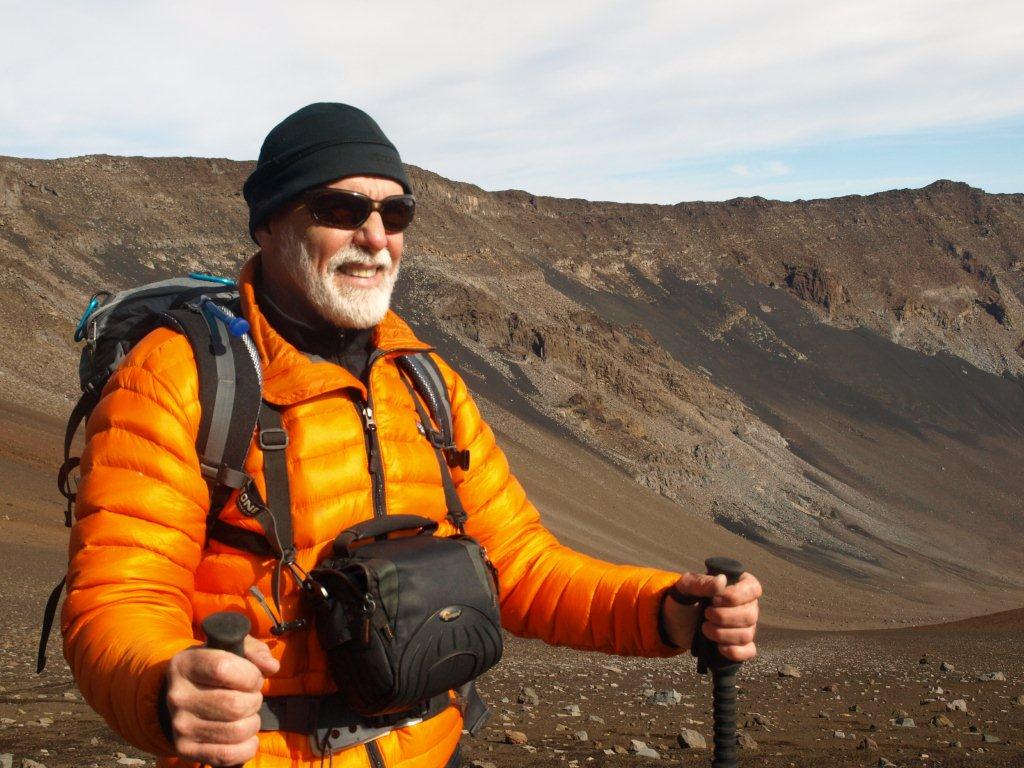
DayHike Haleakala

Haleakala is the highest point on Maui and the largest dormant volcano on earth.  A 2-hour drive in the darkness, climbing uncountable switchbacks, took us from sea-level to about 10,000 feet of elevation.
 
We arrived before dawn to see the sun rise from the east, as we stood at the top of the massive crater. 

The sky and clouds showed spectacular colours, the mist sank down the crater edges, and the sculpted landscape seemed to unfold with the new golden light.

Standing and observing from the top is a memorable experience.  But taking a 16 mile hike down, into, and through the crater is a much richer experience.  It is a rugged hike, with elevation decent and climb of 2000 feet.  The landscape is unearthly, with expansive fields of cinders and lava flows, a desert of sand from eroded peaks, and a very few rare and hardy Hawaiian plants. 


Inside Haleakala is a spectacular experience, but it takes considerable effort to get there.
 
Many ostomates will miss this experience because it’s ‘too physical’, or they could dehydrate, or won’t carry a backpack for fear stoma-rubbing or flange-peeling. 


YES we can.  Ostomates can DayHike to spectacular places.

Maui, February 2012